My First Week Making Hot Dogs With Claude Code Max 20
I was a bit late to the Claude Code party, and started about six months after most of my friends. I openly admit I was pretty hesitant that AI had any shot at taking over coding, but it's slowly won me over in the last few months.
Like most people, I used it at first a bit tepidly, not entirely sure of it's strengths or its weaknesses. Slowly over the first few weeks I started being able to produce decent code consistently, so I thought I should experiment with it a bit more.
I started on the $20/mo plan just to get my feet wet. That's great for small code changes but you quickly run into limits. I then updated the Claude Max 5 ($50/mo) plan. That worked well at first, but if you try to work on more than one project at the same time consistently, you pretty soon end up in the dog house and have to wait until your plan resets. I'm one of those people that doesn't feel creative 24/7, so for me it's important to be creative when I actually feel inspired, and relax or go touch grass when I don't. So I decided to upgrade to the $200/mo plan (Claude Max 20) and see just how much I could do with it in a week.
Here's a list of everything I worked on during my first week, and the results of my experimenting. The TLDR is that it exceeded most of my expectations and helped me bring a few old passion projects back from the dead.
Claude Code Usage Widget
The first idea I wanted to test out was the ability to see Claude's usage in real time to know whether or not I was approaching my daily or weekly limits. You can type /usage in Claude Code, which works of course, but I envisioned something a little more elegant up in my taskbar.
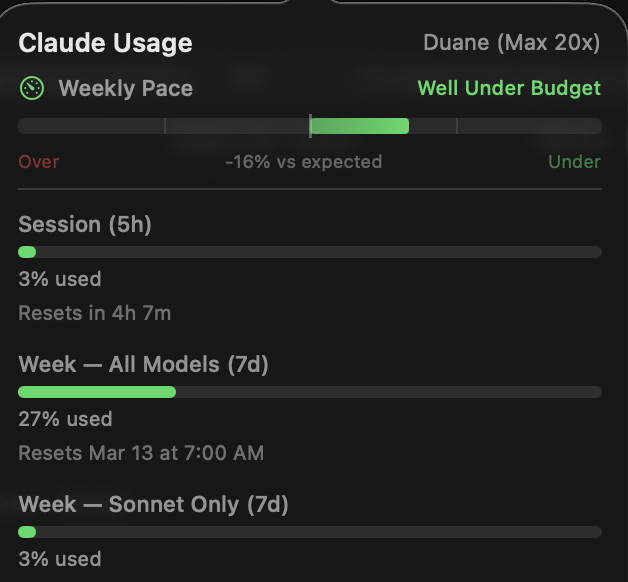
One other idea I had was the idea of a budget indicator, some gauge showing you if you were on track to use up your weekly limit, or were you leaving tokens on the table basically at the end of the week.
I described how the app should work, what settings I wanted, what graphs etc, and let Claude Code go to work. In a few iterations we got the basic premise working, which I slowly improved over the course of the week.
You can install this yourself on Mac OSX if you want - a few other people from X already have and are using it full time now.
- Total Time This Week: 3-4 hours
- Net Result: This widget is super helpful to me to gauge how hard I can push in a given sprint with Claude Code, and a few others are already on X.
Crossroads Static Site Generator
Back when Mullenweg basically decided to detonate a bomb onstage at WordCamp USA, I decided to finally unshackle myself from WordPress and switch to something else. I evaluated a few static site generators like Astro, but I have a real aversion I find to using JS to generate a website, in the same way I have always had some visceral reaction to React.
So in the end I quickly coded up a little PHP static site generator called Crossroads. It has some cool features, like a built in SEO module and a responsive images generator, but I never quite finished it over the Christmas holidays when I started it. So I got Claude Code to help me patch up the pieces that were in need of some repairs and get it back to a state where I could start writing again.
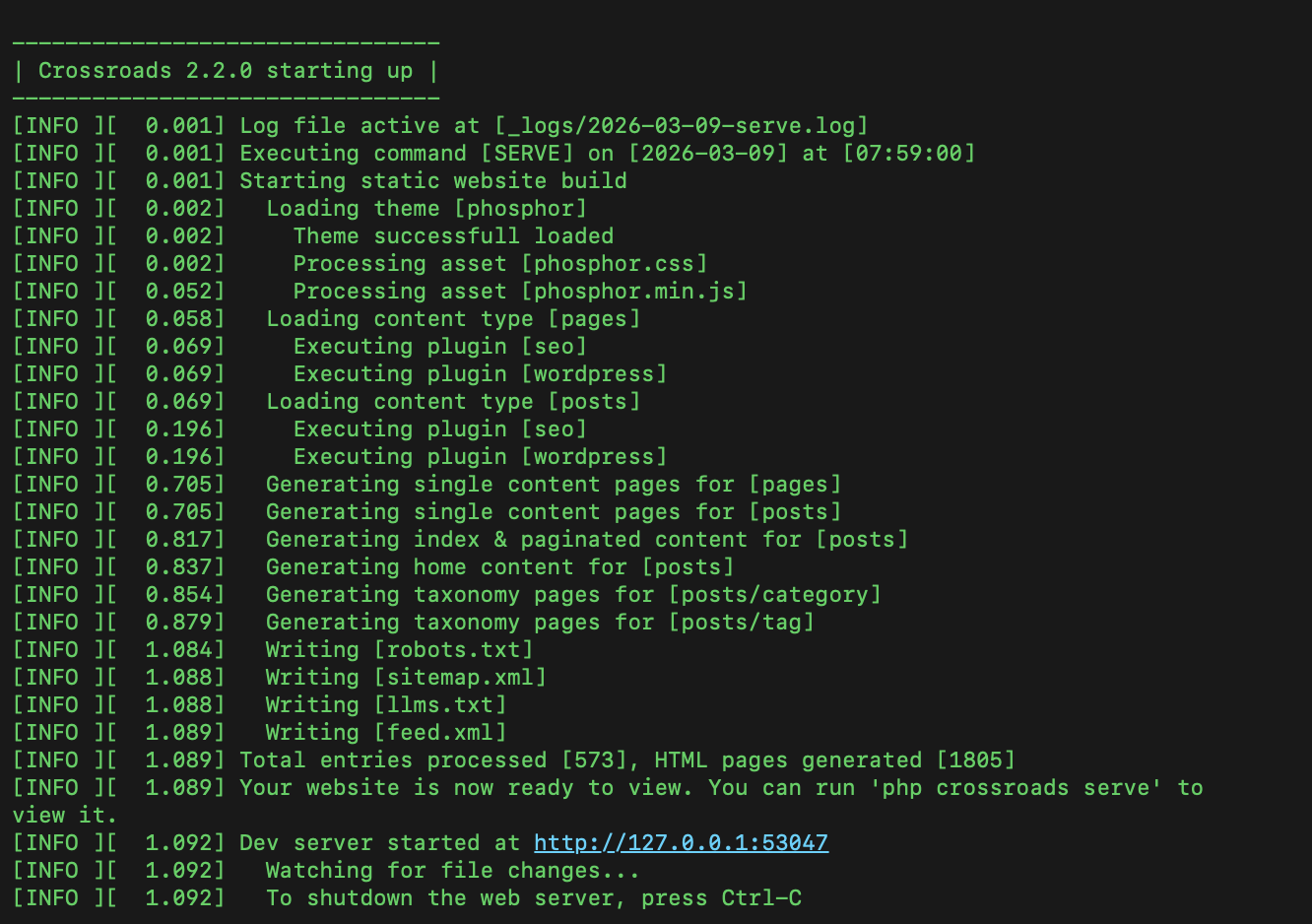
Since AI has become a lot more dominant since the last time I worked on Crossroads, we spent some time at first adding the appropriate meta tags and .md sidecar files to help AI read the content.
I then challenged it to make a late 80s to early 90s inspired theme to remind me of my old computing days on the Commodore 64 and my dad's XT computer. So we came up with a cool retro theme that is part Claude Code and part 90s computer, lovingly called 'phosphor' - that's what you see here running on this website now. The pages were generated by Crossroads, and the theme, phosphor, was designed by me and my AI buddy.
Crossroads uses the latte templating engine so I was curious how it would do - I imagine most of the training was using Blade etc, but it managed to pump out the latte code just as easily.
- Total Time This Week: 3-4 hours
- Net Result: My blog is back online and I feel inspired to write again
Marksmith
A friend of mine shared my recommendation to use Macdown, a Mac-based Markdown editor, with someone on X. The person who received the recommendation didn't seem super impressed with it, saying it seemed a bit dated. Once I saw that, I thought a good challenge for Claude Code would be to write a more improved Markdown editor for Mac OS.
Whenever I start a new project, I try to imagine how it could be different. What are the pain points, especially mine? How can I take something that takes 5 clicks and reduce it down to 2?
So the first items I thought would be cool would be to have direct static site generation ability right within the app - the ability to build your site, and also to preview it.
The second item I thought would be nice is a Git update mechanism (most SSGs live in Git and many people deploy using Github pages or Cloudflare pages) and also the ability to see live Git diffs when I edit content.
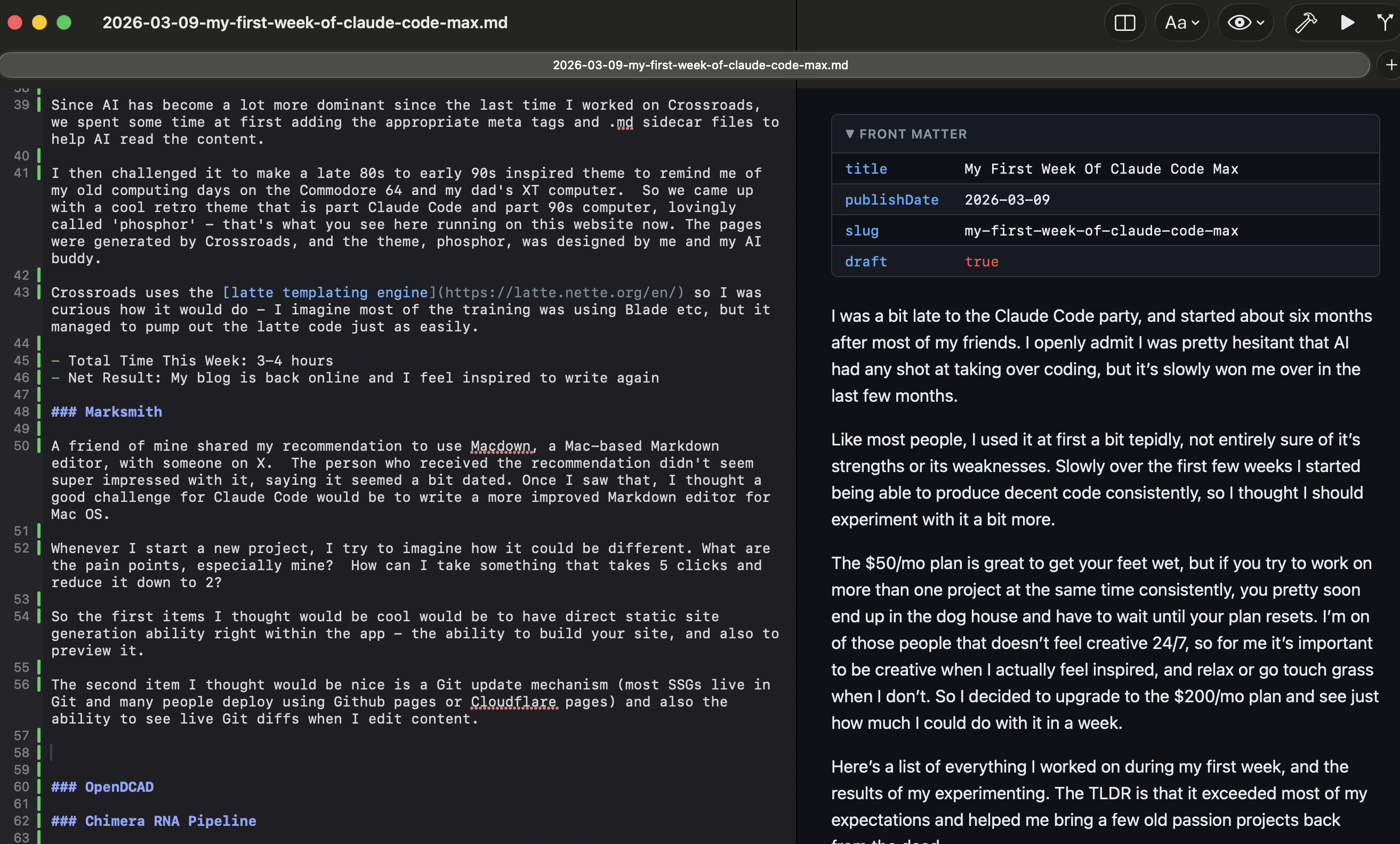
The result is a Mac OS application called 'Marksmith'. It's still a work in progress, but I'm using it already as my own Markdown editor on Mac. I can click the little "Play" button on the top nav bar, which then builds my entire site and lets me click the preview link to view it live. There is also a deploy button which lets me see all the files changed on disk, and push them live to Github, which then starts the Cloudflare deploy process to put my new content live on duanestorey.com.
I wrote this entire post using Marksmith, and also previewed it in the app and pushed it live using the internal Git manager.
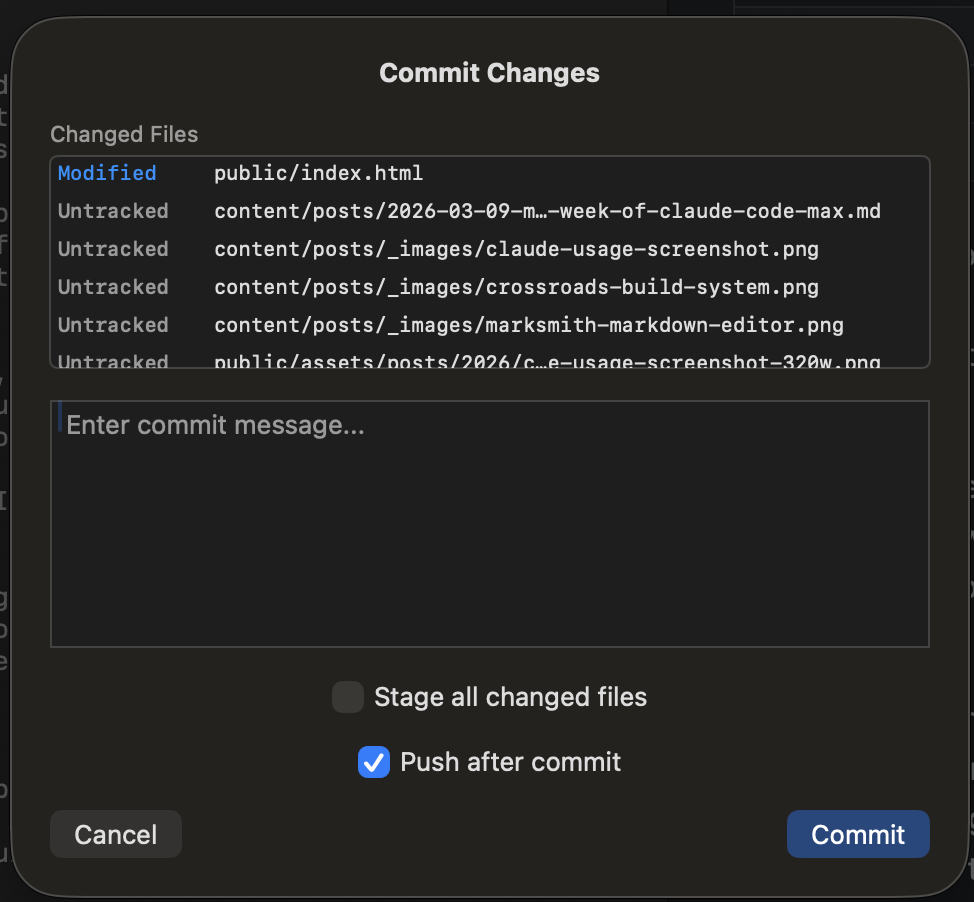
This is yet another work in progress, and needs a few more weeks of love before I'd say it's ready for prime time. But it's already doing the heavy lifting for my SSG in my own workflow.
If you want to install/build Marksmith, you can find Marksmith on Github here.
- Total Time This Week: 3-4 hours
- Net Result: New markdown editor for Mac OS with Git/SSG integration
OpenDCAD
This last year I've been trying to get into hardware in a big way. My background is actually in electrical and computer engineering, even though I have spent most of my life making money by coding. During Covid lockdowns I spent time improving my actual hardware skills by making custom PCBs using Kicad, fabricating them in China, and then building and testing them all myself. My prime audio system in my living room is a hi-fi amplifier I've made entirely from scratch using about 12 custom PCBs and even a custom spec'ed toroidal transformer.
A lot of my newer projects will need custom 3d enclosures. I have two Bambu printers at home, and have done a lot of modelling in OpenSCAD and Tinkercad. The problem with OpenSCAD is it produces STL files, which are basically meshes of triangles. Those render fine, and look like a solid object, but they aren't really an object in the traditional sense - they don't have faces, and solid surfaces etc. That differentiation matters when you actually want to fabricate something professionally, as most injection molding companies can't really work with a STL file, and you can't easily convert a tessellated triangular mesh back into a 3d object with proper faces.
So my solution to the problem was to start working on my own OpenSCAD-like language, but built on top of the OpenCascade open source library. This library is the basis for FreeCAD, which is used by many people professionally. The difference is I didn't see OpenDCAD as having a UI or an interpreter like OpenSCAD, I pictured it as more of a compiler with hot reloading (probably this is a natural instinct based on years of using Vite and Laravel mix etc).
I got pretty far with OpenDCAD, but had to pause when it actually came time to create an entire interpretative language - I have never done that in my entire career, and it involves writing a parsing language and actually building a parse tree. That's pretty hardcore and is how typically compilers work. To finish it off, I would have had to read and research a lot more on how that is done.
I decided to point Claude Code at it to see if it could get me over this hump. This is probably the most important part of this project, as defining the language will either make it or break it in terms of usability. So I was conscious of what every verb in the language meant or didn't mean, and pushed back a few times on how a person would use the language.
Here is the current OpenDCAD language for creating a lithium ion battery pack enclosure.
// Base bin with a fillet
let bin = bin(80,120,20,2).fillet(0.5);

// One battery, built via vector transforms
let battery = cylinder(21/2, 70)
  .translate([0, 0, -35])
  .rotate([0, 90, 0])
  .translate([0, 0, 12]);

// Four-pack arrangement using vector translates
let four = battery
  .fuse( battery.translate([0, 22, 0]) )
  .fuse( battery.translate([0, 44, 0]) )
  .fuse( battery.translate([0, 66, 0]) )
  .translate([0, -40, 0]);
let fourBackup = four;

// Corner offset piece with a vector translate for the inner cut
let piece = cylinder(5, 20)
  .cut( cylinder(4.8/2, 6).translate([0, 0, 14]) );

// Place piece at corners, then fuse the battery pack
let model = bin
  .placeCorners(piece, 34, 54)
  .fuse(four);

// Multiple logical exports; host will write both STEP/STL per id
export model as bin;
export model.cut(piece) as bin_with_cut;
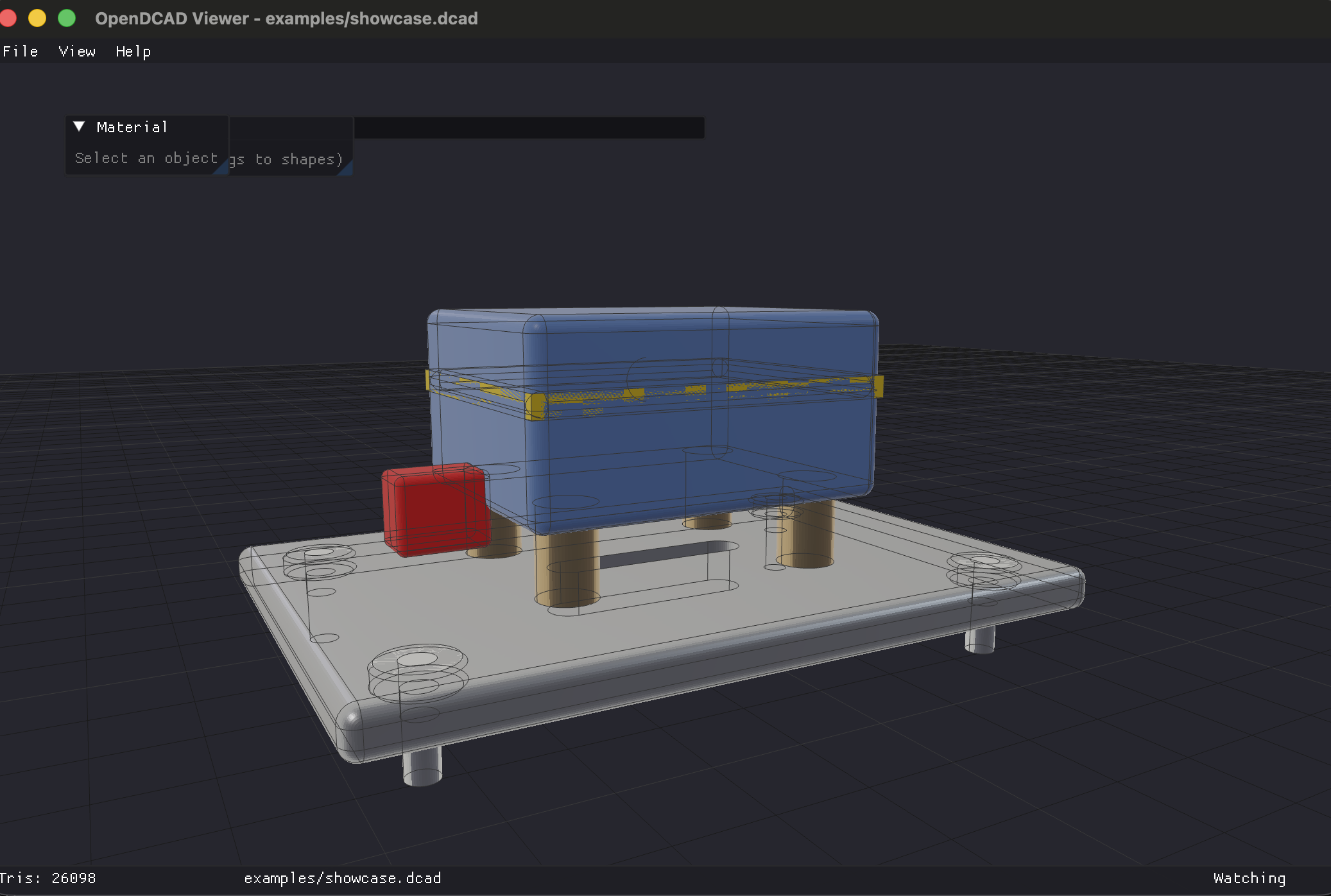
There is still a lot left to do before I release this to the public, as I want to add a full DFM (design for manufacturing) module to it first. I also am adding full material support to the 3d viewer, so you can basically define the entire object programmatically - including what materials everything is made out of - and have it render photo-realistically (I hope). Here is a early alpha version of the 3d viewer which includes colour support:
- Total Time This Week: 4-5 hours
- Net Result: Got me over a really hard bump and closer to the finish line by helping finish the main parsing engine and 3d viewer
Chimera RNA Pipeline
I unfortunately have long covid. It started for me with an infection in December of 2023 that seemed just like any other covid infection I had had. But over the course of six weeks my body just slowly fell apart, and the covid eventually hit my brain and put me in the hospital for two weeks. I spent the next ten months mostly in bed back in Canada trying to pick up the pieces of my life again, and was forced to stop work completely during that period of time due to how ill I was.
I'm part of an amazing study run by Amatica Health that is doing a full RNA analysis of me and another 117 patients to try and understand just what is causing our ill-health. I exchanged a few messages/emails with Jack, one of the people in charge at Amatica, trying to discover just how much more juice we could maybe extract from the RNA fruit.
It turns out RNA provides an incredible amount of data, if you know how to read it right. I used Claude to deep dive all the mechanisms we know for long covid and me/cfs. I then brainstormed over a couple days with what a RNA pipeline would look like to test almost every major theory, and also how to potentially treat it.
Using an AI server I built at home with 28 cores and 64GB of DDR5 RAM, I got Claude Code to help me construct a massive RNA pipeline that could analyze my own FASTQ data file and look for the following:
- what is the state of every transcribed gene in my body - what is it doing?
- what are the pathways that are out of whack? which ones are feeding on each other?
- how many feed forward loops exist in my body - systems that are so out of whack that they have become self sustaining?
- what viruses or bacteria are detected in my blood? What state are they in: hibernating, or actively transcribing?
- is any vaccine material detected in my blood? It shouldn't be there - but is it?
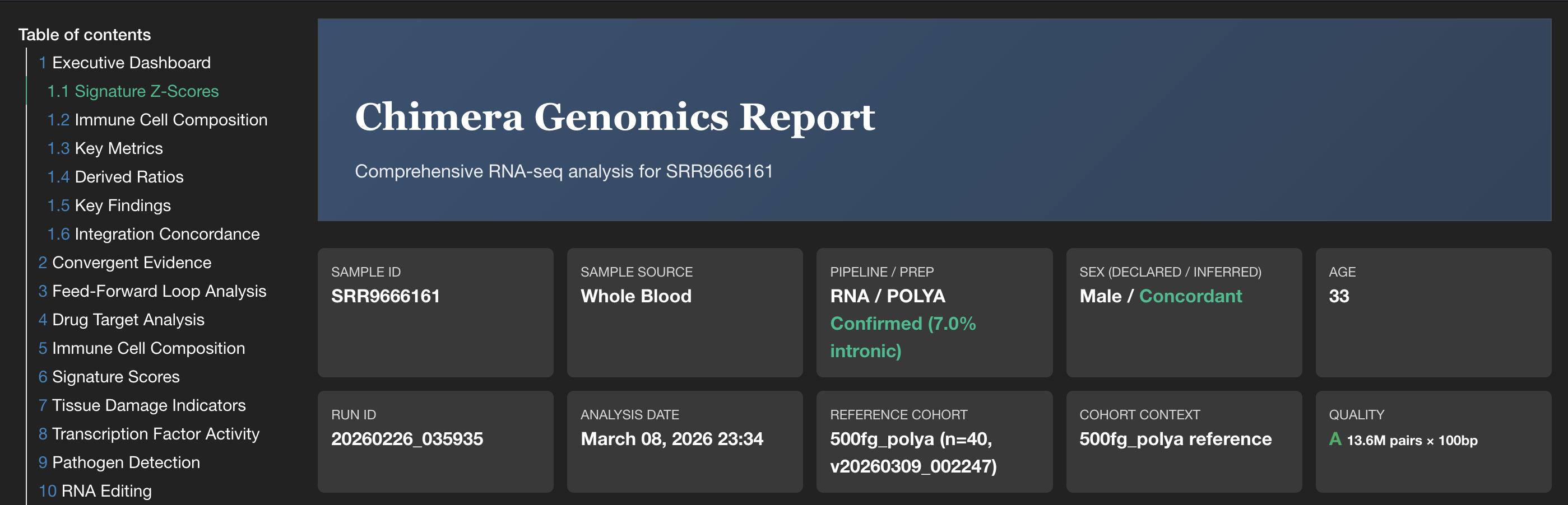
This tool I think will be incredibly valuable, and I was in a unique position to build it I think. Not only do I have some of the most comprehensive labs (thanks to living in Spain) of any long covid patient, I also have the engineering and software background to hopefully put all these pieces together in new and interesting ways (or so I hope).
I'll shortly be able to test this with my own sample, and see just what covid did to me. But if this works, then Claude Code will have helped me improve my health, and maybe the health of others too.
My goal is to get this to a place where any individual or research facility could use this pipeline, but I'm not quite there yet. I'm in the process of dockerizing it and testing it on various cloud providers. But my goal is for someone to git clone the repo, run 'install', and be processing a sample shortly after.
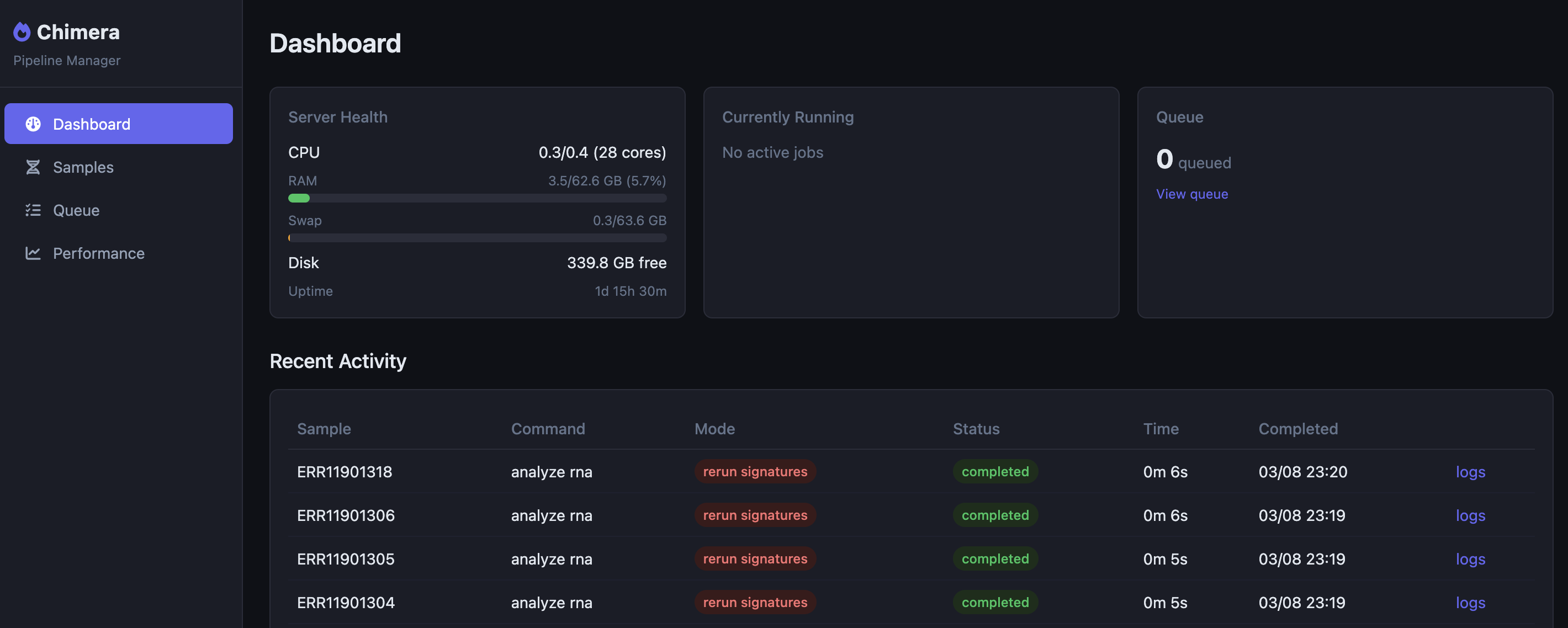
Here is a shot of the web UI interface which can be used to run control or patient samples:
- Total Time This Week: 6 hours (I'm at over 100 hours total on this project so far)
- Net Result: Full RNA processing pipeline UI, reporting, theoretical frameworks, convergent evidence matrix
WordPress Theme Refactor
Probably the task I was the most worried about was a WordPress theme refactor I wanted to do this week as well. I had this large monolithic WordPress project that started as a theme, and probably should have maybe been a plugin or maybe even a standalone Laravel project at some point. But over time a few different people worked on it, and it kind of turned into this Franken-project that was a bit unmanageable. Working on this codebase had started to get a bit cumbersome, and there was too little test coverage for my comfort.
I actually used the 1M context Claude Opus model for this, as I knew this was a difficult refactor. I first used /plan mode to split this refactor into ten logical steps. The general premise was at any stage we could change functionality, or we could change form, never both at the same time. And no refactor would start unless we had adequate regression testing to capture issues.
Some of the tasks we completed incrementally were:
- 2000 pricing unit tests based on the previous code, used as a golden test snapshot of what 'working' looked like
- upgrading the entire build system to something more modern
- refactoring a large monolithic functions.php into a directory tree of more maintainable classes
- busting a Vue based UI apart into pieces that are easier to maintain
- re-organizing the entire project on disk, removing dead code
- converting an entire back-end based on old AJAX patterns into a proper REST API
Lots of moving pieces, and lots that could go wrong. This is about 90% of the way there, and all of our regression tests eventually passed at each stage. This is a huge win if this works (it should) as it basically took a five year old code base and modernized it in a way that will make extending it much easier.
- Total Time This Week: 20 hours
- Net Result: Revitalizing a 5-year old code base with a large code refactor and AJAX -> REST API conversion
Final Thoughts
I watched this great video the other day by an engineer named Mo Bitar who was sort of having an existential crisis (same as all of us) with regards to this new world and how developers or engineers fit in. Probably the analogy he makes that is most apt I think is that most of us felt like we were making steaks before and now we are mostly making hot dogs - AI helps us write code, but it's probably not super beautiful code, and we didn't really work hard for it. It's code, it mostly works. But it doesn't have the elegant and hand-crafted beauty of code we did from hand.
I love writing nice code, and I love a hard challenge. But I'm in my 40s now. Long gone are my days of sitting up until 3am writing a VOIP stack, or a jitter buffer. I did that years ago, and I have so many great memories of coding into the wee hours of the night with a 2L of diet coke next to me. But I feel like I've been there and done that. There are only so many software problems you can solve, and after a while a lot of them start to feel the same. A lot of what we call software development today is mostly glorified CRUD manipulation.
As this post demonstrates, this past week I was able to move forward a lot of passion projects that I had to neglect mainly due to lack of time. And sure, I didn't write a ton of code for most of these (some, I didn't write any). But I'm ok with that. For me the thrill isn't the code writing anymore - that's the means to the end, not the end. The thrill is being able to iterate quickly and test ideas without compromising my health by staying up until 2am every night trying to test something out. I don't get super excited by getting Claude Code to write a generic markdown editor. What I do find exciting is trying to get it to integrate Git into that editor and also a SSG build system. Those are the mashups that get me excited, not the 40 hours of keyboard pounding it took to even test that idea.
So yes, we now live in a world of hot dogs, or at least sausage. But we don't have to make the cheap Walmart brand stuff. I plan on making some nice BBQ smokies myself, and I still feel like I can add my own special type of BBQ sauce to make that smokie taste even better. Sure, I may not know where all the meat in that sausage came from, but that was even true before when I said import react or import vue into a project - I didn't write any of that code either.
My goal with this week was to push Claude Code Max 20 to its limits, and myself I guess, to see how many parallel projects I could work on at the same time. It was a fun exercise, and it helped me fully understand just how powerful AI is and what we can do with it. My brain can handle five projects on the go at once, but you do feel it - at some point you do have to step away from the computer and just relax a bit as even saying "continue" feels draining if you're actively reading what it's doing and making sure it doesn't get off track. I never once hit a weekly limit, or even an hourly session limit, but your mileage may vary. But I'd rather pay a bit more to make sure I'm never cut off prematurely from a coding session that be forced to put the keyboard down when my brain is racing and the creative juices are flowing.
At this point thanks to AI we are mostly limited by our imagination, so I think those who embrace that and let their creativity flow through it will do well in this new world. The original goal of the Pixar animation studio was to bring 3d animation to the masses. It turned out that was possible, but that wasn't where the magic ended up being. The magic was guys like John Lasseter using those tools to produce beautiful stories that moved us. And it's up to us engineers and developers to use these AI tools the same way, not just to produce generic hot dogs, but to add our own special sauce to something hopefully a little more tasty and wholesome.