Long Covid: Attempted 90 Day Fix
One of the inherent problems with getting a long covid diagnosis is immediately coming to terms with the fact that most doctors aren't comfortable treating patients with that diagnosis, and if you're lucky enough to find one, very few offer any suggestions. We've been instructed repeatedly to pace ourselves, get a good sleep, drink lots of water, take our omega 3s. But outside of that, we haven't been offered many solutions, certainly not enough for most people to regain any quality of life.
After I received a long covid diagnosis here in Spain by two specialists (and here it's called covid persistente), I was invited to join a community run WhatsApp group of long covid patients in the Valencian community. It was only then did I really understand the magnitude of the problem, as the gaslighting.
Inside that group, it was clear that most people felt rather alone and unheard. Many had been passed from specialist to specialist, often waiting three months or more for each appointment, only to be told there wasn't much to be done and that they should just see another specialist.
My last appointment ended up roughly the same. I met with a specialist in internal medicine here in Valencia, Spain. That doctor is typically a specialist in infectious diseases as well, and I figured with my nearly 20 pages of lab results showing high cytokines, a dysregulated immune system, high checkpoint inhibitors, extremely high covid19 spike and nucleacapsid antibodies, and a full viral panel that I would immediately get some kind of help. Instead the doctor flipped the pages like he was rather bored, asking me about life in Canada and what brought me to Spain. In the end he ignored all my labs and simply said high cytokines were not specific, and that I should just try to lose a bit weight instead. Despite spending the last year so disabled I wasn't able to work for eight months, the only solution to my dilemma he could offer me was Mounarjo.
I can't complain really. Despite the magnitude of my poor labs, I'm still rather functional compared to most people. I have frequent crashes where I feel ill, I have a hard time sleeping. I have brain fog that impacts my day, and I can go from feeling 80% well to about 20% well in about 15 minutes, enough to make it so I need to lie down for a few hours. But inside that WhatsApp group are people who can't work at all, and others who are bed bound. Some people can't even make it to a doctor's appointment, let alone beg for medince.
Action Plan
Around the time I found that WhatsApp group, I was seeing a clinical immunologist. She was a lovely person, and was the first person to actually believe this was covid related, and for that I'm thankful. But her background was more in helping women with immune issues become pregnant, not helping with long covid. She did what she could to help, but most of her treatment relied on herbs and supplements. I think those have a use, and do help to a small extent. But my labs were 20x normal, and my fridge already looked like a health food store. I really felt I needed bigger guns, ones that she clearly didn't have access to or was comfortable prescribing.
At that point I decided to try and come up with my own treatment plan, one that incorporated aspects of all the ongoing clinical trials going on in the long covid space. Pretty much everyone I know who has long covid that has made any sort of progress has done it themselves, often sourcing the medicines they need from pharmacies in China or India.
I knew of course anything I came up with would be experimental, and I knew it might not work. But seeing some people in what WhatsApp group who continued to deterioriate year over year to the point where they were mostly non functional made it clear to me that trying something, anything, was better than just the status quo. I worked hard to get to where I was in life, I don't want to give up so easily.
AI To The Rescue
I realize some people in the medical community are split on really how helpful or maybe hurtful AI is at this point when it comes to medicine. As for me, without AI I wouldn't even know I have long covid. Doctor's basically misdiagnosed me with an acute mental illness when I showed up six weeks post-covid with neurological issues. It was only 15 months later, when ChatGPT o3 looked at my labs and suggested I had a cytokine storm, that I starteed investigating further.
I did a deep dive on most of the current research regarding long covid and came up with several simultaneous arms I wanted to try for my treatment, guided of course by my own labs. My main two elevated pro-inflammatory cytokines are inteluekin 1-beta, which was 238 last time I checked it, and interlueken 6, which hovers between 40 and 80. My goal was to drop those down right away, hopefully giving me some relief.
I still don't know why they are high, and to that end I'm going to assume viral persistence - that is, there is likely some antigen source in me, likely my gut or brain, that is still taunting my immune system. Since many of my symptoms have been neurological, and IL1-beta is associated with neuroinflammation, I feel pretty strongly my brain or CNS is involved.
Lastly, I needed to come up with a way to resolve my exhausted T cells. I explored a few different options, but decided to continue using thymosin alpha 1, but timed in appropriate parts of the therapy. I also wanted to focus on autophagy as well, in case there were encapsulated viral particles hanging around.
With all of that in mind, and using several AI agents including ChatGPT o3 and the new GPT 5, I hashed out a 90 day trial.
Long-COVID Protocol — Staged Plan (with references)
The following represents a comprehensive plan to try and address all the potential theorized issues that might be causing my long covid19 symptoms. It includes steroids and JAK stat inhibitors to blunt the elevated cytokines, multiple complementary anti-virals to address viral persistence, immune modulators such as maraviroc, coclchicine, and sirolimus, and thymosin alpha 1 to help rebuild the struggling T-cell pool.
Stage 1 — “Knock down the fire”
- What we’re doing: Short pulse of dexamethasone to blunt the early cytokine surge.
- Why it helps: Corticosteroids reduce hyperinflammation and improve outcomes in severe COVID (RECOVERY/NEJM).
- Goals: Short term symptomatic relief while providing steroid responsiveness in terms of labs
- Relevant Labs: IL6 - 40-80 (normal < 7)
Stage 2 — “Debulk replicating virus”
- What we’re doing: Paxlovid (nirmatrelvir/ritonavir) early for 5 days.
- Why it helps: Protease inhibition reduces progression and shortens viral shedding when started early (EPIC-HR/NEJM).
- Relevant Labs: Persistently high spike (2500 BA/ml) + nucleocapsid N IgG declining extremely slowly - if this decay rate increases, it might imply persistent antigen exposure
Stage 3 — “Hold replication pressure down”
- What we’re doing: Extended sofosbuvir/daclatasvir (SOF/DCV) for ~8 weeks.
- Why it helps: Small trials/pooled analyses suggest clinical benefit in acute COVID; we use it as a long-tail replication check (SOF/DCV clinical data).
Stage 4 — “Block potential reverse-transcription noise”
- What we’re doing: Keep TDF/FTC (Truvada) on board during months 1–2.
- Why it helps (theoretical): NRTIs can inhibit LINE-1 activity; if endogenous RT contributes to persistent antigen, an NRTI backbone may reduce it (NRTIs ↔ LINE-1 evidence).
Stage 5 — “Mute the cytokine amplifiers”
- What we’re doing: JAK inhibition (tofacitinib bridge → baricitinib).
- Why it helps: JAK1/2 blockade down-regulates IL-6/IFN signaling; RCTs showed improved outcomes in hospitalized COVID (Baricitinib RCTs).
Stage 6 — “Cool IL-1β / NLRP3”
- What we’re doing: Colchicine 0.6 mg daily, extended while IL-1β is high.
- Why it helps: Colchicine inhibits NLRP3 inflammasome and IL-1β maturation; tested in large outpatient RCTs (Colchicine/NLRP3).
- Relevant Labs: Last IL1-beta was 238 (normal < 13.6)
Stage 7 — “Reprogram immunity without wiping it out”
- What we’re doing: Low, steady-dose sirolimus (mTORC1 inhibitor).
- Why it helps: mTORC1 inhibition induces autophagy and moderates aberrant immune activation—useful when persistent antigens/debris are suspected (Sirolimus/autophagy).
Stage 8 — “Loosen protein/amyloid ‘glue’ + cover microbes”
- What we’re doing: Doxycycline alongside sirolimus/JAK.
- Why it helps: Doxy can disrupt/inhibit amyloid fibrils and is an MMP inhibitor with anti-inflammatory effects (Doxycycline ↔ amyloid/MMP).
Stage 9 — “Stabilize endothelium & throttle EV traffic”
- What we’re doing: Pitavastatin (resume/titrate).
- Why it helps: Statins support endothelium and can reduce extracellular-vesicle (EV) release, dampening vascular inflammation (Statins ↔ EV/endothelium).
Stage 10 — “Rebuild T-cell tone while the noise is low”
- What we’re doing: Thymosin-α1 (Tα1) three times weekly through most of the program.
- Why it helps: Tα1 supports DC/T-cell function and helps rebalance Th1/cytotoxic responses during recovery (Tα1 immune modulation).
Lab Methodology
Many of these drugs are processed by the kidneys and the liver. As such, I got AI to help me craft an ongoing testing strategy with pre-defined off-ramps in case any of my labs started to deteriorate. In general we have two main panels, stagerred every two weeks. And then a few extended panels to capture the overall state of my entire immune situation.
- Panel 1: Core: including CBC, Creatinine, Liver Enzymes, hsCRP, Electrolytes
- Panel 2: Extended: Core + IL6 + CK
The core panel primarily is meant to track my health in terms of the interventions, and the extended is meant to track the interlueken six, which should hopefully track my ongoing inflammatory cytokines. If IL6 continues to trend down, I'll take that as a measure of success.
- Panel 3: IgG Antibodies: Covid 19 Spike IgG, Covid 19 Nucleocapsid IgG
My COVID19 antibodies once dropped at a roughly predicable rate of around 60-70 days. When I started measuring them after my horrific December 2023 infection, I noticed they were hardly declining at all. This could simply reflect long lived plasma cells, but I also think there is a chance it reflects ongoing antigen exposure. My plan is to continue to track these - if the decay curve changes drastically, I think it likely meant the IgG levels were being maintained by active antigen exposure, which would be indirect proof of viral persistence.
- Panel 4: Lymphocytes, Checkpoints, Cytokines: This is the big dog, which will be used to track my immune exhaustion markers, my pro and anti inflammatory cytokines, and a full lyphocyte and Th helper subset panel. These were the labs that initially really helped me understand what was happening inside my body, so I'll continue to use these to gauge improvement.
Once I start sirolimus, I'll do one or more trough measurements to dial it in.
In terms of offramps:
- CK >3× ULN with myalgia or >5× ULN without → hold statin (± colchicine); recheck 48–72 h
- ALT/AST >5× ULN, or >3× ULN with bili >2× ULN → hold Sof/Dac; recheck 48–72 h
- eGFR drop >25% or K⁺ >5.4 → hydrate, review meds, repeat (hold likely offender)
- Sirolimus trough >8 → 1 mg QOD; <2 and doing well → consider cautious uptick if needed
Pre-Trial Labs
Foundational metrics: eGFR >100 mL/min/1.73m²; HbA1c 4.7%; TSH 1.8 mIU/L (fT4/fT3 upper half per report).
| Marker | Result | Reference Range | Role in Inflammation |
|---|---|---|---|
| GM-CSF | 6.0 pg/mL | ≤3.0 pg/mL | Pro-inflammatory (myeloid activation, immune cell proliferation) |
| IFN-α | 7.20 pg/mL | ≤10.0 pg/mL | Pro-inflammatory (antiviral response), can be immunoregulatory |
| IFN-γ | 133.0 pg/mL | ≤25.0 pg/mL | Pro-inflammatory (Th1 activation, macrophage stimulation) |
| TNF-α | 25.6 pg/mL | ≤8.1 pg/mL | Pro-inflammatory (master cytokine for systemic inflammation) |
| IL-1β | 238 pg/ml | ≤13.6 pg/mL | Pro-inflammatory (fever, leukocyte recruitment) |
| IL-2 | 2.90 pg/mL | ≤12.0 pg/mL | Pro-inflammatory (T cell proliferation), immune regulatory |
| IL-4 | 26.9 pg/mL | ≤25.0 pg/mL | Anti-inflammatory (Th2 skew), but can drive allergic inflammation |
| IL-5 | 41.0 pg/mL | ≤10.0 pg/mL | Pro-inflammatory (eosinophil activation, allergic inflammation) |
| IL-6 (July) | 65.70 pg/mL | ≤4.50 pg/mL | Pro-inflammatory (acute phase response, chronic inflammation driver) |
| IL-6 (Aug) | 45.2 pg/mL | ≤7.0 pg/mL | Pro-inflammatory (acute phase response, chronic inflammation driver) |
| IL-9 | 6.50 pg/mL | ≤3.00 pg/mL | Pro-inflammatory (mast cell growth, Th2 enhancement) |
| IL-10 | 51.30 pg/mL | ≤20.0 pg/mL | Anti-inflammatory (limits immune damage, suppresses Th1) |
| IL-12p70 | 278.3 pg/mL | ≤20.0 pg/mL | Pro-inflammatory (Th1 differentiation, NK activation) |
| IL-17A | 15.90 pg/mL | ≤10.0 pg/mL | Pro-inflammatory (neutrophil recruitment, tissue inflammation) |
| Marker / Subset | Result | Reference Range | Pattern | Description |
|---|---|---|---|---|
| Lymphocytes (T) | 834 /mm³ | 876–1,900 | Low-normal | Total T cells slightly low; may reflect chronic activation & trafficking into tissues |
| % T cells of lymphocytes | 61.8% | — | Normal | Proportion of T cells within lymphocyte pool |
| T4/T8 ratio | 3.1 | 1.0–3.0 | High-normal | Skew toward helper T cells; seen in chronic activation, some autoimmune patterns |
| CD8 Activated (T8act) | 45 /mm³ (23.6%) | 80–300 | Low | Fewer activated cytotoxic T cells than expected; may indicate functional exhaustion |
| CD8 Senescent (T8sen) | 12 /mm³ (6.1%) | 15–250 | Low | Low senescent CD8 pool; young population, possibly due to turnover |
| Cytotoxic/Senescent ratio (T8c/T8s) | 15.1 | 1.0–6.0 | High | Indicates predominantly fresh cytotoxic cells vs. worn-out cells |
| T8 Effector Memory (T8 EM) | 14.0% | 15.0–58.0 | Slightly low | Suggests less tissue-patrolling CD8 memory; may impact long-term antiviral surveillance |
| Soluble IL-2 Receptor (IL2r) | 43.12% | 7.0–25.0% | High | Marker of T cell activation; often elevated in chronic immune activation & autoimmunity |
| Monocytes – Classical (Mon C) | 96.5% | 75.0–96.0% | High-normal | Skew toward inflammatory monocyte subset; vascular repair (non-classicals) reduced |
| usCRP | 0.46 mg/dL | ≤0.30 | Slightly high | Low-grade systemic inflammation; matches IL-6 elevation |
Viral Panel
| Name | Value | Reference | Pos/Neg | Comments |
|---|---|---|---|---|
| Parvovirus B19 IgG | 6.29 | ≤2.50 | Positive | Past or persistent exposure; possible reactivation marker if symptoms match |
| Varicella Zoster IgG | 2,546 mIU/mL | ≤175.0 | Very high | Past infection and/or recent vaccination; strong VZV-specific immunity |
Acute‑phase: hsCRP 1.65 mg/L (low/normal for you); fibrinogen 3.94 g/L (high‑normal).
Planned Timeline
The following is the rough timelime for intervention and tests.
| Dates | Day(s) | Medications & Doses |
|---|---|---|
| Aug 8–9 | 0 | Paxlovid 300/100 mg BID · Sof/Dac ½ tab QD · TDF/FTC QD · Dexamethasone 16 mg · Hold statin |
| Aug 9 | 1 | Paxlovid 300/100 mg BID · Sof/Dac ½ tab QD · TDF/FTC QD · Dexamethasone 8 mg |
| Aug 10 | 2 | Paxlovid BID · Sof/Dac ½ tab QD · TDF/FTC QD · Dexamethasone 4 mg |
| Aug 11–13 AM | 3–5 | Paxlovid BID (last dose Aug 13 AM) · Sof/Dac ½ tab QD · TDF/FTC QD |
| Aug 14 | 6 | Sof/Dac ½ tab QD · TDF/FTC QD |
| Aug 15 | 7 | Sof/Dac full tab QD · TDF/FTC QD · Pitavastatin 1 mg QD · Start Tα1 1.6 mg SC M/W/F (Dose #1) · Labs |
| Aug 16 | 8 | Start Tofacitinib XR 11 mg QAM or IR 5 mg BID · Start Colchicine 0.6 mg QD · Continue Sof/Dac full tab, TDF/FTC QD, Pitava 1 mg, Tα1 M/W/F |
| Aug 17–Sep 6 | 9–29 | Sof/Dac full tab QD · TDF/FTC QD · Tofacitinib + Colchicine 0.6 mg QD · Pitavastatin 1 mg QD · Tα1 M/W/F |
| Sep 7 | 30 | Stop Tofacitinib · Start Baricitinib 4 mg QD · Start Sirolimus 1 mg QD · Add Doxycycline 100 mg BID · Continue Colchicine 0.6 mg QD, Sof/Dac full tab, TDF/FTC QD, Pitava 1 mg, Tα1 M/W/F |
| Sep 8–Oct 3 | 31–56 | Baricitinib 4 mg QD · Sirolimus 1 mg QD · Doxycycline 100 mg BID · Colchicine 0.6 mg QD · Sof/Dac full tab QD · TDF/FTC QD · Pitavastatin 1 mg QD · Tα1 M/W/F |
| Oct 5–Oct 7 | 58–60 | Stop Sirolimus Oct 5 (unless extending) · Stop Sof/Dac and TDF/FTC Oct 7 · Continue Baricitinib, Colchicine, Pitava, Tα1 M/W/F |
| Oct 5–Nov 2 (opt.) | 58–84 | If extended: Continue Sirolimus 1 mg QD + Doxycycline 100 mg BID + Baricitinib 4 mg QD + Colchicine 0.6 mg QD + Pitava 1 mg QD + Tα1 M/W/F |
| Nov 2 | 84 | Stop Sirolimus and Doxycycline (if extended) · Continue Baricitinib, Colchicine, Pitava, Tα1 (if still on) |
| Nov 5 | 90 | Stop Baricitinib, Colchicine, and Tα1 (if still active) |
So hopefully as I approach November, I'll have some idea about weather or not any of this works or can make a noticable improvement.
Medication Requirements
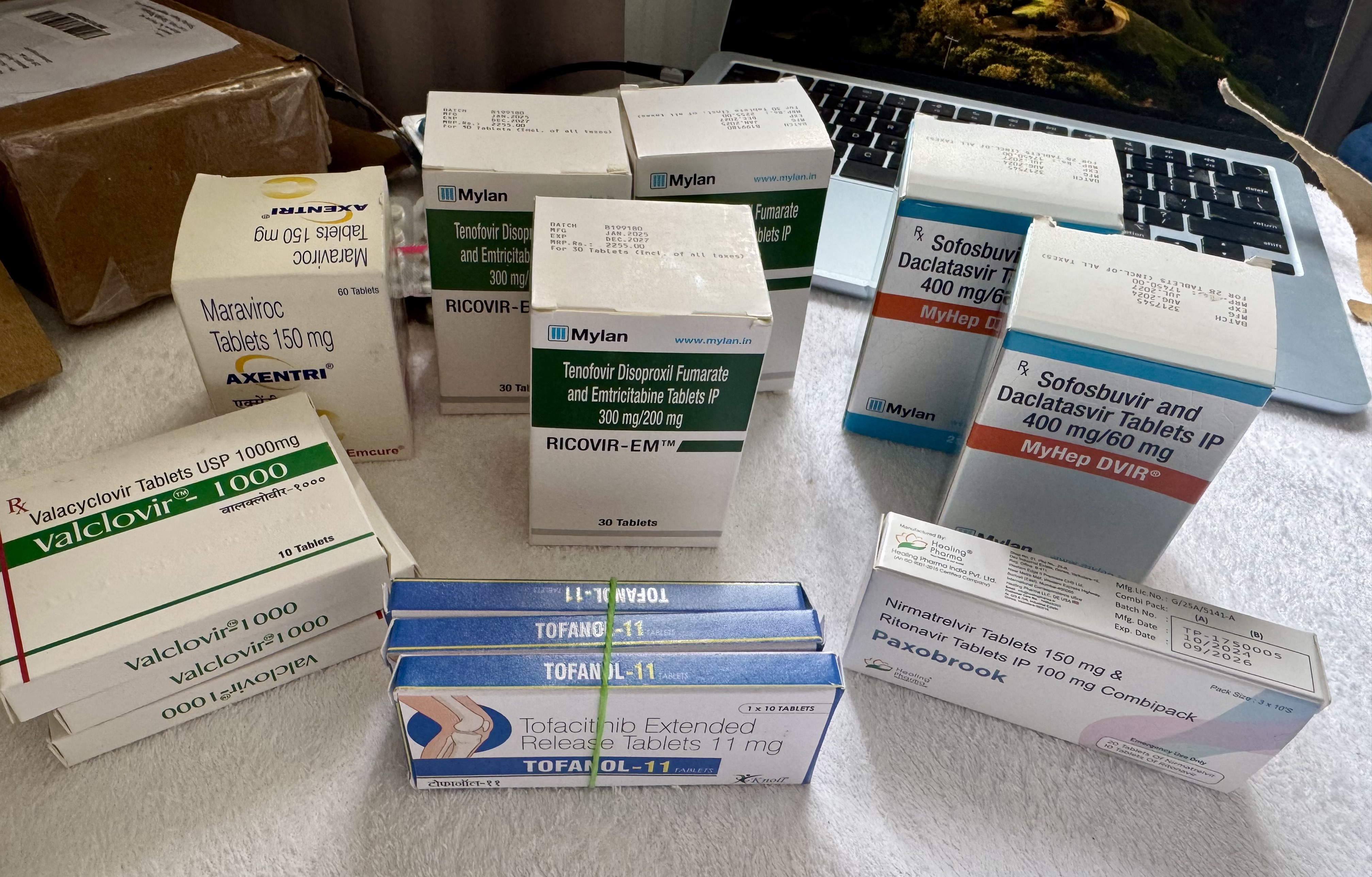
Here is a very rough list of the medication I'll require during this. As I don't have a doctor overseeing this, I had to source most of this myself from various well-known online pharmacies. Getting those medicines into the EU was more difficult than I thought, but not impossible.
| Medication | Daily Dose / Schedule | Duration (Days) | Total Units Needed |
|---|---|---|---|
| Paxlovid | 150/100 mg BID | 5 | 15 tablets |
| Sofosbuvir/Dac | ½ tab QD (Aug 8–14), then full tab QD | 60 | 53.5 tablets (~54) |
| TDF/FTC (Truvada) | QD | 60 | 60 tablets |
| Dexamethasone | 16 mg (Day 0), 8 mg (Day 1), 4 mg (Day 2) | 3 | 3 tablets |
| Pitavastatin | 1 mg QD | 90 | 90 tablets |
| Tα1 | 1.6 mg SC M/W/F (~3/wk) | 77 | 33 injections |
| Tofacitinib | XR 11 mg QD (or IR 5 mg BID) | 22 | 22 XR / 44 IR |
| Colchicine | 0.6 mg QD | 90 | 90 tablets |
| Baricitinib | 4 mg QD | 60 | 60 tablets |
| Sirolimus | 1 mg QD | 60 | 28 tablets |
| Doxycycline | 100 mg BID | 28 | 56 capsules |
I also have additional paxlovid in case I have success and want to try a longer trial of that at some point.
Results and Journal
The following represent my journal entries during this experience, along with any relevant laboratory results along the way. I'll likely be doing full blog entries every two weeks, which I'll loop back and link to from here so keep the data with one main source.
| Date | Symptoms/Improvements/Labs |
|---|---|
| Aug 8, 2025 | Shingles vaccine - headache |
| Aug 9, 2025 | Felt horrific last night. Hardcore headache from vaccine. Started steroids this morning, felt great a few hours later. Crashed in the afternoon. High HR notifications either from vaccine +120bpm |
| Aug 10, 2025 | Total shit sleep last night, only two hours. HR warnings up to 120bpm. 5:50pm - HR down to 85-90 now, better. - Tinnitus slightly better? |
| Aug 11, 2025 | Slept much better last night, heart rate stabilizing. Feeling energized. - Tinnitus seems better. Strange. |
| Aug 12, 2025 | Horrible sleep, wired brain last night. Strangely HRV is up today. Why? 7:30pm, tinnitus barely audible. Will be interesting to track what happens as dexa wears off. Up 3 lbs from dexa though I think. |
| Aug 13, 2025 | Tinnitus is still quiet, but dexa levels in blood are roughly 8mg still |
| Aug 15, 2025 | -- |
| Aug 16, 2025 | Lab Day - Started Jak Stat inhibitor. Spent the day in Gdansk. Felt ok in the morning, but crashed after a while. |
Conclusions
Forthcoming, stay tuned!