80 Day Antiviral Protocol Against Sars-Cov-2
Not that long ago I finished approximately 80 days of antivirals in an attempt to perturb a potential sars-cov-2 reservoir in myself, one of the leading candidates for a cause (of perhaps a few) for long covid itself.
While I have no direct evidence that there is actively replicating virus inside of me, I do have a substantial amount of indirect evidence such as:
- My IgG antibodies for the nucleocapsid are high and have been rising over time
- My IgG antibodies for the spike have been declining at a snail's pace over the last two years
- My cytokines clearly have demonstrated active engagement with something, and all my attempts to find what it is always come back to covid itself
I find it hard to imagine any scenario where antibodies against an antigen can continue to increase over a period of months or years without their being some kind of ongoing exposure. While exposure to 'fragments' is possible, most RNA and cellular tissues degrade on the orders of hours or days, so it's also unlikely to me that my body is still encountering random debris from my infection 28 months ago.
So in an attempt to test this theory, I set up to test a series of antivirals that the long covid community has mostly been trying off label off and on for years.
Prior Trials
There have been several mostly disappointing trials using antivirals against perceived viral persistence of Sars-Cov-2 in the last few years. While the results of these have been largely negative, the trials themselves have been inadequate for the following reasons:
- No biomarkers were used to segment people. While no biomarkers really exist for long covid yet, even segregating people into their antibodies titres would have been better than nothing, as well as cytokine status (i.e. does it look like the body is still responding to something)
- Only one antiviral was used, typically paxlovid. If we can take any lessons from other viruses that establish reservoirs like HIV and HCV, it seems pretty unlikely that mono therapy, using one antiviral on its own, would be successful.
Unfortunately people have started associated the failure of these tests as proof there isn't viral persistence, but that's of course an inference. Paxlovid targets Mpro, and if there is a slowly replicating reservoir, it's probably one of the least suitable targets due to slow turnover. Also, without proper segmenting any signal would likely be dwarfed by noise, so we should be careful not to let lack of evidence be used as evidence of lacking.
Baseline Labs
Eurofins Spike/RBD IgG
These labs measured my IgG against Spike/RBD at a lab in Spain called Eurofins. What's notable is my relatively normal IgG decline in December and January of 2021/2022, corresponding to natural decay mechanics after vaccination. I had a booster shot shortly after the Jan 20, 2022, which is captured by the relatively large increase on February 4th, 2022. The decay between these two points represents a half-life of approximately 70 days.
Also of note is that after my December 2023 infection that led to long covid, my antibodies have been decaying very slow, occasionally even going up slightly. The last three points represent an estimated half-life of about 233 days.
| Date | Result | Unit |
|---|---|---|
| 2021-12-28 | 504.6 | UA/mL |
| 2022-01-20 | 389.0 | UA/mL |
| 2022-02-04 | 11,481.9 | UA/mL |
| 2022-05-13 | 4,355.0 | UA/mL |
| 2025-05-23 | 15,338.8 | UA/mL |
| 2025-06-23 | 14,400.5 | UA/mL |
| 2025-09-15 | 10,380.2 | UA/mL |
| 2025-10-16 | 9,805.8 | UA/mL |
| 2026-01-23 | 10,670.7 | UA/mL |
| 2026-02-26 | 9,132.9 | UA/mL |
| 2026-03-31 | 8,745.9 | UA/mL |
Teletest S1 IgG
These tests show the IgG antibodies against the S1 region for Sars-Cov-2. What they seem to show is a decline in 2025, followed by a rise of about 40% through the year, ending up only slightly below where it started 8 months prior.
| Date | Result | Unit | Ref | Notes |
|---|---|---|---|---|
| 2025-05-22 | 139.0 | AU/mL | ≤1.00 | Positive |
| 2025-07-02 | 100.0 | AU/mL | ≤1.00 | Positive |
| 2025-09-10 | 145.0 | AU/mL | ≤1.00 | Positive; rebound |
| 2026-01-22 | 116.0 | AU/mL | ≤1.00 | Positive |
Teletest Nucleocapsid IgG (infected derived)
And probably the most informative IgG is against the nucleocapsid itself, as this only comes from an actual infection, not the vaccine. The first three points show a half-life decay of approximately three years, followed by a moderate increase by January 22, 2026.
| Date | Result | Unit | Ref | Notes |
|---|---|---|---|---|
| 2025-05-22 | 46.5 | index | ≤1.00 | Positive |
| 2025-07-02 | 43.2 | index | ≤1.00 | Positive |
| 2025-09-10 | 42.5 | index | ≤1.00 | Positive |
| 2026-01-22 | 58.6 | index | ≤1.00 | Positive |
Teletest Nucleocapsid IgM
I had one IgM (nucleocapsid) measurement for Sars-Cov-2 in May of 2025, and it was negative. This will be important later.
| Date | Result | Unit | Ref | Notes |
|---|---|---|---|---|
| 2025-05-22 | 0.53 | index | ≤1.00 | Negative |
Cytokines
The first lab test that gave me any indication that something was wrong (other than the acute psychosis and subsequent year off I had to take from work due to feeling like I was mostly dying), was a high interlueken 6 value. Once I had that, I started pulling the rest of my labs apart and discovered most of my cytokines were heavy expressed, indicating some kind of ongoing immune system level reaction against something.
Teletest Cytokines — Pro / Innate / TH1 Axis
All values pg/mL. Bold values are out of range. Cutoff: before antiviral trial start / Day 0.
| Date | IFN-y | IL-12p70 | IL-6 | TNF-alpha | IL-2 | IL-17A | IFN-alpha | GM-CSF |
|---|---|---|---|---|---|---|---|---|
| 2025-05-23 | 89.7 | 89.7 | 40.25 | 14.2 | 2.0 | 17.7 | 5.8 | 6.8 |
| 2025-07-03 | 133.0 | 278.3 | 65.7 | 25.6 | 2.9 | 15.9 | 7.2 | 6.0 |
| 2025-09-10 | 92.7 | 101.6 | 39.3 | 20.3 | 0.2 | 12.6 | 4.1 | 5.1 |
| 2026-01-21 | 164.7 | 330.9 | 58.3 | 31.6 | 20.9 | 19.9 | 12.1 | 9.1 |
| Reference range | ≤25.00 | ≤20.0 | ≤4.50 | ≤8.1 | ≤12.00 | ≤10.00 | ≤10.00 | ≤3.0 |
Teletest Cytokines — TH2 / Regulatory Axis
All values pg/mL. Bold values are out of range. Cutoff: before antiviral trial start / Day 0.
| Date | IL-10 | IL-4 | IL-5 | IL-9 |
|---|---|---|---|---|
| 2025-05-23 | 26.3 | 19.4 | 22.3 | 2.6 |
| 2025-07-03 | 51.3 | 26.9 | 41.0 | 6.5 |
| 2025-09-10 | 38.4 | 18.6 | 30.7 | 2.7 |
| 2026-01-21 | 60.2 | 28.2 | 49.8 | 2.4 |
| Reference range | ≤20.00 | ≤25.0 | ≤10.00 | ≤3.00 |
Cytokine Interpretation
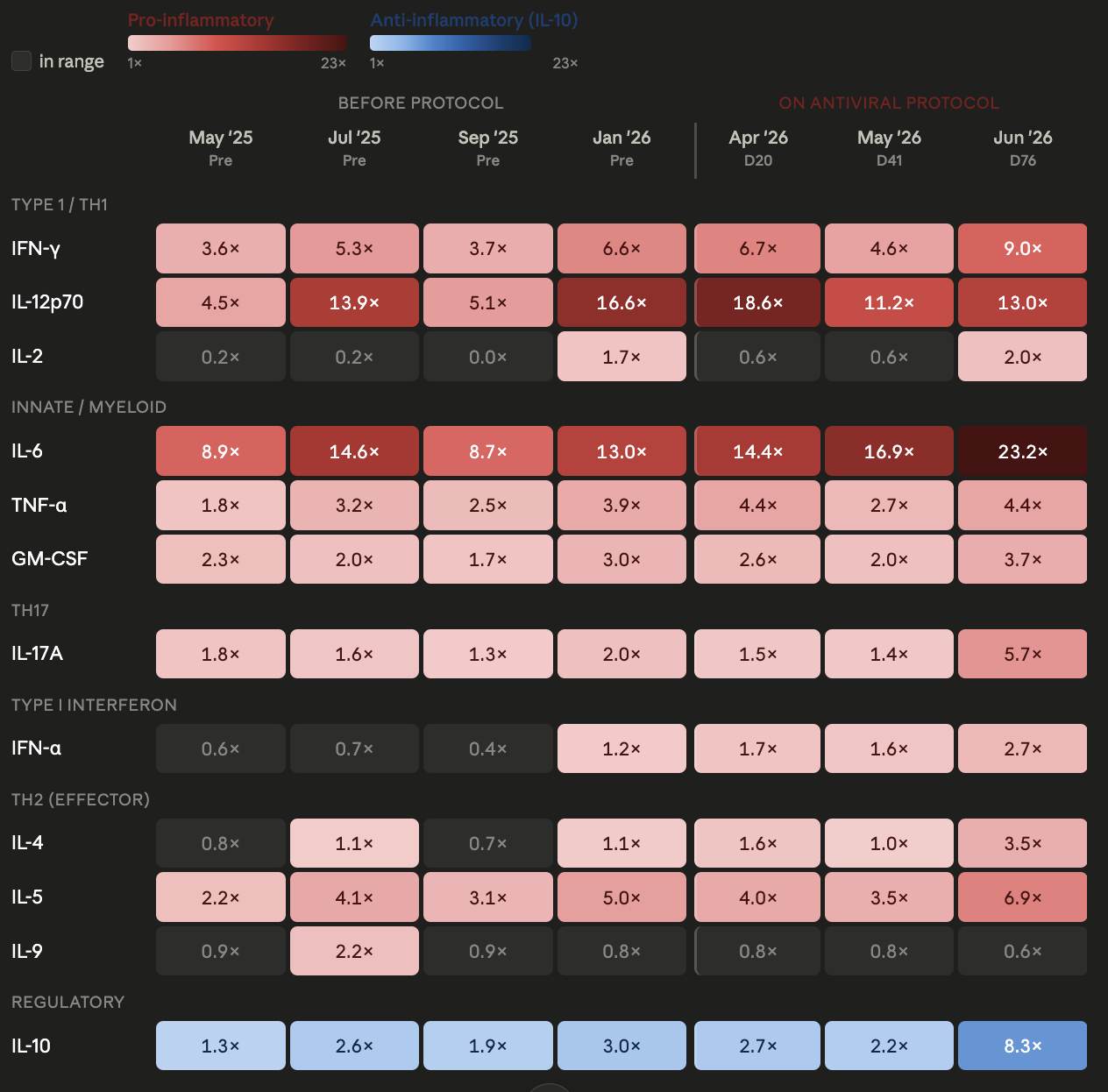
To get a better sense of what the cytokine data is showing, it helps to view it visually.
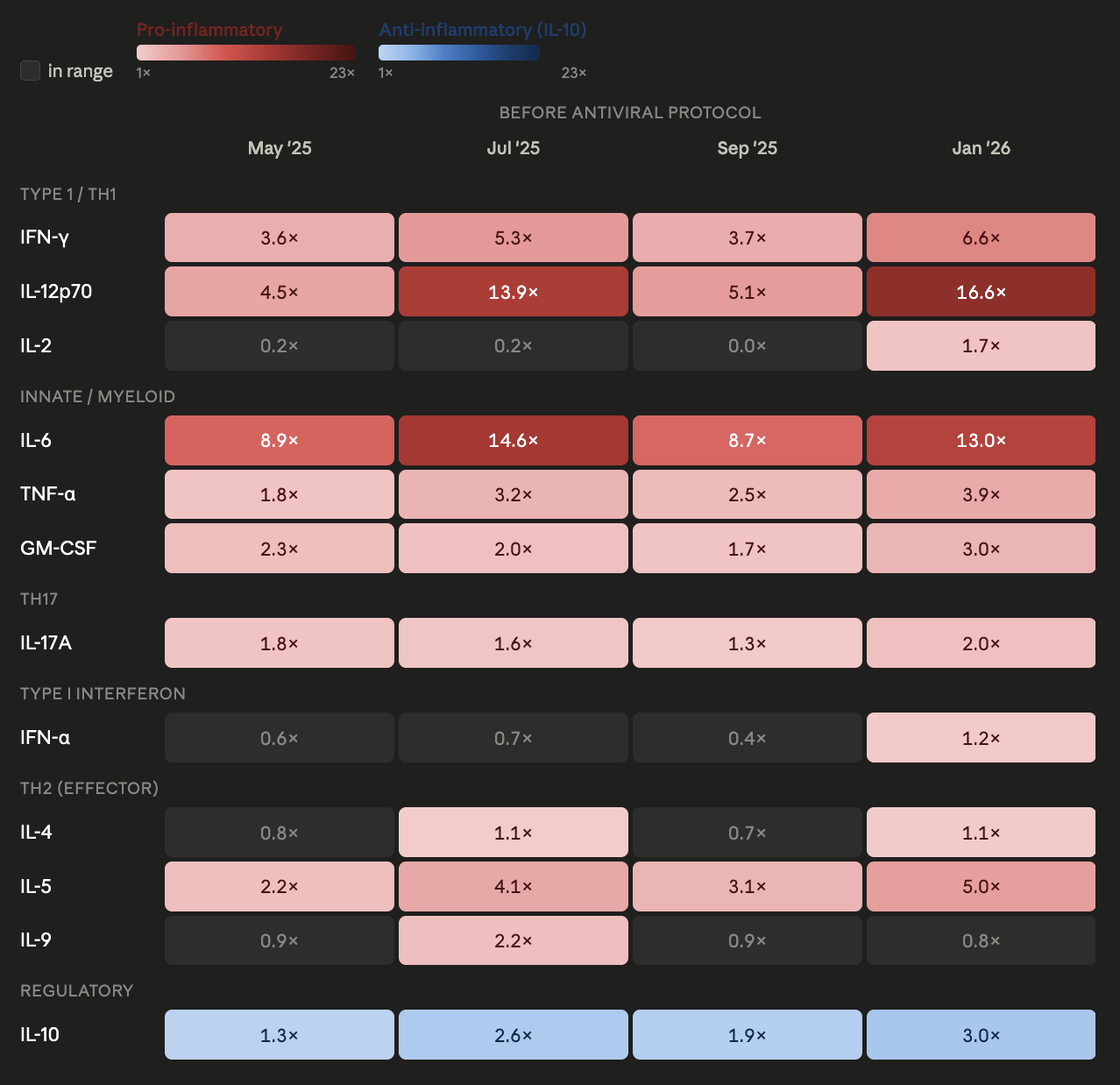
When I ask AI (since it likely understands cytokines better than I do) to summarize the entire state, this is what it suggests:
Overall, this is a picture of broad, sustained, and episodically flaring immune activation rather than a quiet or resolving one. Across nine months and four timepoints, the great majority of measured cytokines sit above their reference limits at every draw, with two synchronized surges (July 2025 and January 2026) that lift all arms together. The signal is loudest in the type‑1/Th1 and innate‑inflammatory axes — IL‑12p70 and IL‑6 are the standout drivers, with IFN‑γ, TNF‑α, and GM‑CSF consistently elevated — but it is not a cleanly polarized response: there is genuine Th2 activity (a persistent, eosinophil-leaning IL‑5 signal), modest but constant Th17 (IL‑17A), a late antiviral type‑I interferon rise (IFN‑α crossing range in January), and an engaged but out-competed regulatory arm (IL‑10 climbing to ~3× yet failing to normalize the pro-inflammatory cytokines). The most recent draw is the highest for most markers, so the trajectory is broadening and intensifying, not settling.
In terms of what it's compatible with: a persistent, type‑1-dominant, pan-activated cytokine signature of this kind is the immunological fingerprint of ongoing, unresolved antigenic or inflammatory drive — most commonly a chronic or persistent/reactivating infection (the IL‑12/IFN‑γ dominance plus the late IFN‑α bump fits a viral or intracellular-pathogen stimulus, which squares with the "antiviral trial" framing), an autoinflammatory or autoimmune process, or another chronic immune-activation state.
Results